
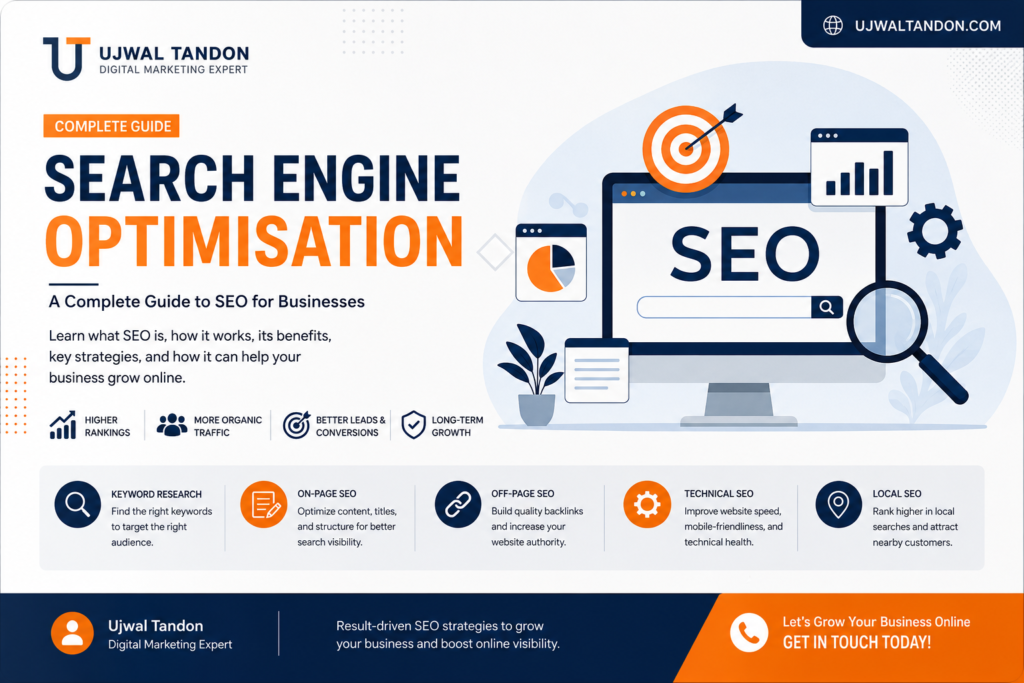
Having a website is insufficient in the modern digital world.Your potential customers need to be able to find your website when they search for products, services, or information online. This is where Search Engine Optimisation becomes important.
Enhancing a website to make it show up more prominently in organic search results is known as search engine optimisation, or SEO.A well-planned SEO strategy can help businesses increase visibility, attract relevant visitors, build credibility, and generate more opportunities online.
Whether you run a small business, personal brand, e-commerce store, or professional service website, Search Engine Optimisation can become an important part of your digital marketing strategy.
What Is Search Engine Optimisation?
The technique of enhancing various elements of a website to aid search engines in comprehending its content and presenting it to visitors for pertinent queries is known as search engine optimisation.
Search engines such as Google use automated systems to discover, understand, and rank web pages. When your website is properly optimised, search engines have a better understanding of what your pages are about.
SEO can involve:
- Keyword research
- Content optimisation
- Website structure
- Technical improvements
- Internal linking
- Image optimisation
- Link building
- Local SEO
- Mobile optimisation
- Improving user experience
The goal is not simply to rank for keywords. The real goal is to attract the right audience and provide useful information that satisfies their search intent.
How Does Search Engine Optimisation Work?
Search engines generally follow several steps before displaying a webpage in search results.
The Basic SEO Process
User Search → Crawling → Indexing → Understanding Search Intent → Ranking → Website Visit
1. Crawling
Search engines use automated programs to discover webpages and follow links across websites.
2. Indexing
After discovering a page, the search engine analyses and stores information about that page in its index.
3. Understanding Search Intent
Search engines try to understand what a user actually wants when they type a query.
For example, someone searching for “how does SEO work” probably wants educational information, while someone searching for “SEO services” may be looking for a service provider.
4. Ranking
Search engines evaluate many signals to determine which pages are useful and relevant for a particular search.
5. Showing Results
The search engine displays the pages it considers most relevant to the user’s query.
This is why effective Search Engine Optimisation requires more than simply adding keywords to a webpage.

Why Is Search Engine Optimisation Important for Businesses?
Potential clients may find your company more easily if you have a strong internet presence.
Search Engine Optimisation can help businesses:
- Increase organic website traffic
- Improve online visibility
- Reach people actively searching for their services
- Build brand awareness
- Generate relevant leads
- Improve website usability
- Establish online credibility
- Support long-term digital growth
- Reduce dependence on paid advertising
One major advantage of SEO is that organic visibility can continue generating traffic after the initial optimisation and content work has been completed.
However, SEO is a long-term strategy. Results depend on factors such as competition, website authority, content quality, technical health, industry, and consistency.
Types of Search Engine Optimisation
Search Engine Optimisation is not one single activity. It consists of several areas that work together.
On-Page SEO
On-page SEO focuses on elements that exist directly on your webpages.
Important areas include:
- Page titles
- Meta descriptions
- Headings
- Keywords
- Content
- Internal links
- URLs
- Images and alt text
- Search intent
Good on-page SEO makes your content easier for both search engines and visitors to understand.
Off-Page SEO
Off-page SEO focuses on activities outside your website that can contribute to its authority and reputation.
Examples include:
- Quality backlinks
- Digital PR
- Brand mentions
- Relevant guest contributions
- Online reputation building
The quality and relevance of links are generally more important than simply collecting a large number of backlinks.
Technical SEO
Technical SEO focuses on the technical foundation of your website.
It can include:
- Website speed
- Mobile responsiveness
- HTTPS
- XML sitemaps
- Robots.txt
- Crawlability
- Indexability
- Website architecture
- Canonical URLs
- Structured data
- Core Web Vitals
A technically healthy website gives search engines a better opportunity to crawl and understand its pages.
Local SEO
Local SEO is particularly useful for businesses serving specific geographic areas.
It can involve:
- Google Business Profile optimisation
- Local keywords
- Customer reviews
- Local citations
- Location pages
- Consistent business information
For example, a digital marketing professional targeting customers in a specific city can optimise their website for relevant local searches.
Search Engine Optimisation vs Paid Advertising
SEO and paid advertising are different digital marketing strategies.
| Search Engine Optimisation | Paid Advertising |
| Focuses on organic visibility | Focuses on paid visibility |
| Usually takes time to build | Can generate visibility quickly |
| Does not charge for every organic click | Often charges based on clicks or impressions |
| Builds long-term organic presence | Useful for short-term campaigns |
| Requires ongoing optimisation | Requires ongoing advertising budget |
For many businesses, the best approach is not choosing one over the other. Combining SEO with paid advertising can help businesses capture both immediate and long-term opportunities.
Key Elements of a Successful Search Engine Optimisation Strategy
A successful SEO campaign starts with understanding the business, audience, competitors, and search behaviour.
Important elements include:
Keyword Research
Identify terms your potential customers actually search for.
Look at:
- Search intent
- Search volume
- Competition
- Relevance
- Commercial value
- Long-tail keywords
High-Quality Content
Create content that answers real questions and provides useful information.
Avoid creating pages simply to include keywords. Every page should have a clear purpose.
On-Page Optimisation
Optimise titles, headings, content, URLs, images, and internal links so that each page clearly communicates its topic.
Technical Optimisation
Make sure search engines can crawl, understand, and index your important pages.
Link Building
Earn relevant and trustworthy links from websites that can provide genuine value and authority.
Performance Tracking
Monitor organic traffic, rankings, impressions, clicks, conversions, and other relevant metrics to understand what is working.
How to Improve Search Engine Optimisation on Your Website
If you are starting with SEO, focus on the fundamentals first.
Simple SEO Checklist
- Research relevant keywords
- Understand search intent
- Create original and useful content
- Optimise page titles
- Write clear meta descriptions
- Use logical H1, H2, and H3 headings
- Improve website loading performance
- Make your website mobile-friendly
- Add relevant internal links
- Optimise images
- Fix broken links
- Create an XML sitemap
- Build quality backlinks
- Monitor website performance
- Update outdated content
Consistency is one of the most important parts of Search Engine Optimisation. Publishing one article and never updating your website is unlikely to create sustainable growth.
Common Search Engine Optimisation Mistakes to Avoid
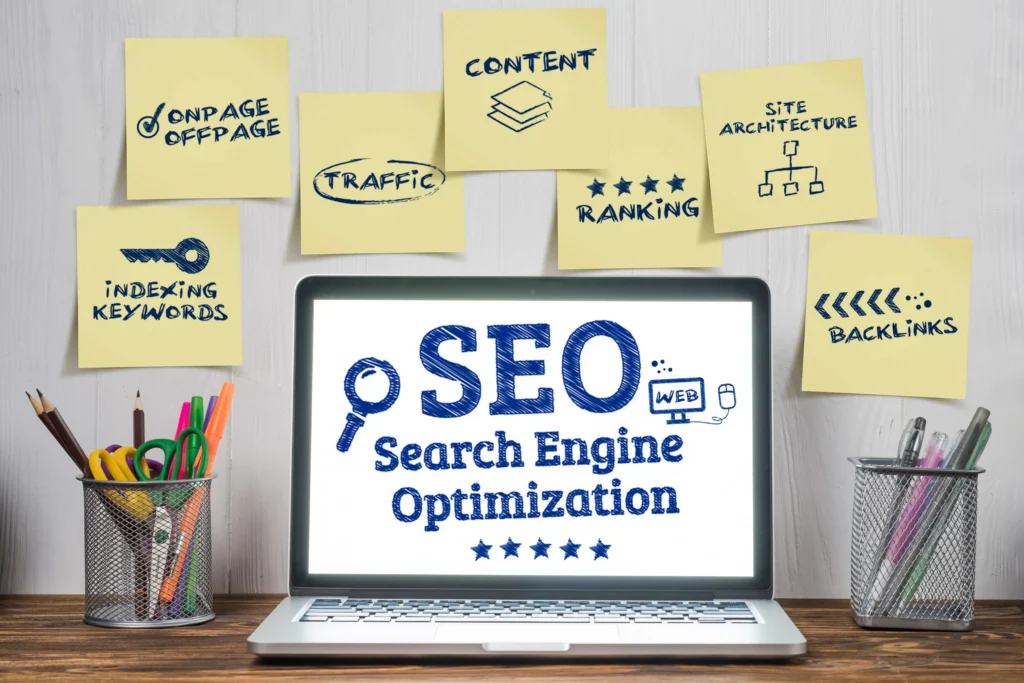
Even well-intentioned SEO efforts can cause problems when the fundamentals are ignored.
Some common mistakes include:
- Keyword stuffing
- Using irrelevant keywords
- Publishing duplicate content
- Buying poor-quality backlinks
- Ignoring technical SEO
- Creating content without understanding search intent
- Ignoring mobile users
- Having slow webpages
- Focusing only on rankings
- Expecting immediate results
The purpose of Search Engine Optimisation should always be to create a better experience for your audience while making your website easier for search engines to understand.
How Long Does Search Engine Optimisation Take?
There is no universal timeline for SEO results.
Some websites may see improvements relatively quickly, while competitive industries can require much more time and effort.
Results can depend on:
- Website history
- Domain authority
- Industry competition
- Content quality
- Technical condition
- Backlink profile
- Keyword difficulty
- Existing organic visibility
- Consistency of optimisation
For this reason, businesses should treat SEO as an ongoing investment rather than a one-time task.
How to Measure Search Engine Optimisation Performance
Tracking performance helps you understand whether your strategy is moving in the right direction.
Useful SEO metrics include:
- Organic traffic
- Search impressions
- Click-through rate
- Keyword rankings
- Organic conversions
- Backlinks
- Indexed pages
- Engagement metrics
- Leads generated through organic search
Tools such as Google Search Console and Google Analytics can help website owners understand how users discover and interact with their websites.
Remember that rankings are only one part of the picture. A keyword ranking is valuable when it contributes to relevant traffic, leads, sales, or another meaningful business objective.
Is Search Engine Optimisation Still Worth It?
Yes. For businesses that depend on online discovery, organic search can remain an important source of potential customers.
Search behaviour continues to evolve, and businesses need to focus on creating useful, trustworthy, accessible, and relevant online experiences.
Modern Search Engine Optimisation should therefore be about more than chasing rankings. It should connect your website content with what your audience actually needs.
A strong SEO strategy combines technical foundations, useful content, relevant keywords, good user experience, authority building, and continuous improvement.
Search Engine Optimisation Services by Ujwal Tandon
At Ujwal Tandon, digital marketing strategies can be designed to help businesses improve their online presence and reach more relevant customers.
SEO can be combined with other digital marketing activities depending on your business goals.
Services can include:
- SEO strategy
- Keyword research
- On-page SEO
- Technical SEO
- Local SEO
- Content optimisation
- Competitor research
- Website optimisation
- Performance tracking
Instead of using the same strategy for every business, the focus should be on understanding the website, audience, industry, competition, and business objectives.
Want to improve your website’s online visibility? Get in touch with Ujwal Tandon and discuss your digital marketing goals.
Frequently Asked Questions About Search Engine Optimisation
1. What is Search Engine Optimisation?
Search Engine Optimisation is the process of improving a website so that search engines can better understand its content and users can discover it through relevant organic searches.
2. Why is Search Engine Optimisation important?
SEO can help businesses improve organic visibility, attract relevant website visitors, build credibility, and generate potential leads without relying entirely on paid advertising.
3. What are the main types of SEO?
The main types include on-page SEO, off-page SEO, technical SEO, and local SEO. These areas work together to create a complete SEO strategy.
4. How long does SEO take to show results?
There is no fixed timeline. Results depend on competition, website condition, content, authority, keywords, technical factors, and the consistency of the SEO strategy.
5. Is SEO better than paid advertising?
Neither is automatically better. SEO focuses on organic visibility and long-term growth, while paid advertising can provide faster visibility. Many businesses benefit from using both.
6. Can small businesses benefit from SEO?
Yes. Small businesses can use SEO to target relevant keywords, local searches, niche audiences, and specific customer needs.
7. Can I do SEO myself?
Basic SEO can be learned and implemented yourself. However, more technical or competitive projects may benefit from professional SEO and digital marketing expertise.
8. What is the most important part of Search Engine Optimisation?
There is no single factor that guarantees success. A strong strategy combines useful content, relevant keywords, technical health, good user experience, authority, and consistent optimisation.
Conclusion
Search Engine Optimisation is an important part of modern digital marketing. It helps businesses make their websites easier to discover, understand, and use.
From keyword research and content creation to technical SEO and local optimisation, every part of an SEO strategy contributes to your website’s overall organic presence.
The key is to focus on users first, search intent second, and sustainable optimisation throughout the process.
If you want to build a stronger online presence and attract more relevant visitors, investing in a well-planned Search Engine Optimisation strategy can be a valuable step toward long-term digital growth.
Digital Marketing: Grow Your Business Online
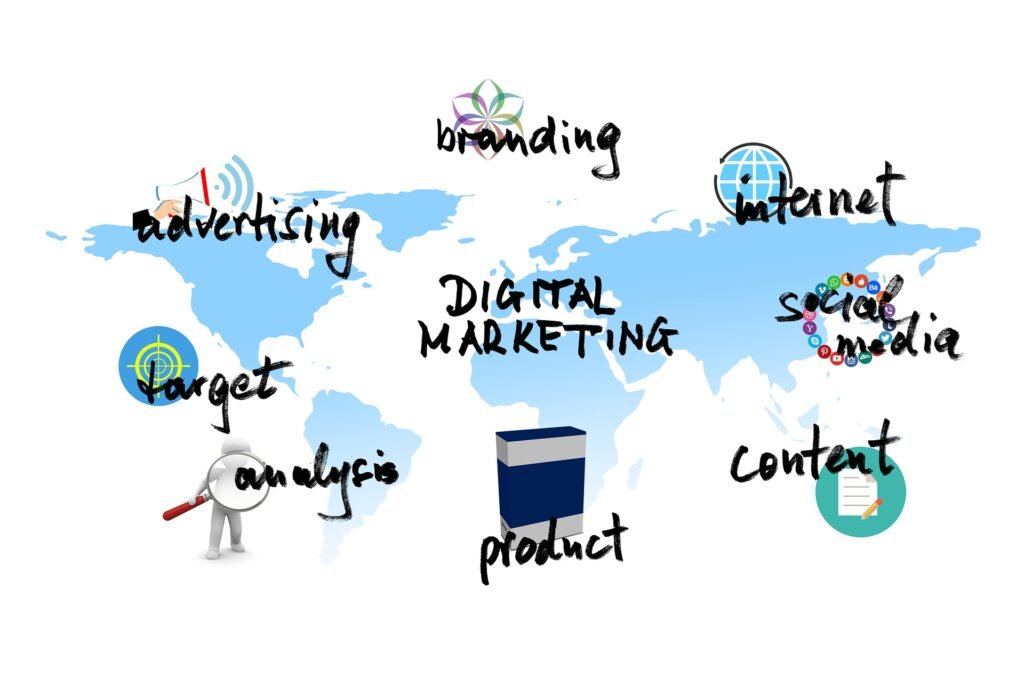
In today’s internet environment, one of the best methods for businesses to contact clients is through digital marketing. It uses digital channels such as search engines, social media, websites, email, and online advertising to promote products and services. Whether you run a small business, personal brand, or large company, digital marketing can help you build visibility and connect with the right audience.
What Is Digital Marketing?
Digital marketing refers to all marketing activities performed through digital platforms. Instead of depending only on traditional advertising, businesses can use online strategies to attract potential customers, build relationships, and increase sales.
A strong digital marketing strategy focuses on reaching customers where they spend their time—online. It also allows businesses to measure results and understand which campaigns are working.
Why Is Digital Marketing Important?
Digital marketing gives businesses an opportunity to reach a much larger audience without requiring a huge advertising budget. With the right strategy, even a small business can compete with established brands online.
Another major benefit is measurable performance. Businesses can track website visits, clicks, leads, conversions, engagement, and other important metrics. This information helps marketers improve campaigns and make better decisions.
Major Types of Digital Marketing
There are several important areas of digital marketing, including:
- Search Engine Optimization (SEO): Helps websites appear higher in search engine results.
- Content Marketing: Uses blogs, articles, videos, and other content to attract and educate audiences.
- Social Media Marketing: Promotes brands and engages customers through social platforms.
- Pay-Per-Click Advertising (PPC): Uses paid advertisements to generate targeted traffic and leads.
- Email Marketing: Helps businesses communicate directly with existing and potential customers.
- Website Marketing: Optimizes a website to attract visitors and turn them into customers.
How Does Digital Marketing Work?
Digital marketing usually starts with understanding the target audience. Businesses identify who their ideal customers are, what they need, and how they search for solutions online.
Next, marketers create valuable content and choose suitable channels to reach the audience. SEO can attract organic traffic, social media can increase engagement, and paid advertising can provide faster visibility.
The final step is analyzing performance. Marketers study data and make improvements based on the results. This creates a continuous process of attracting, engaging, converting, and retaining customers.
Benefits of Digital Marketing
Digital marketing offers several benefits for businesses. It can improve brand awareness, increase website traffic, generate leads, build customer relationships, and support sales growth.
It also provides flexibility. Campaigns can be adjusted based on audience behavior and performance. This makes digital marketing a practical choice for businesses of different sizes and industries.
Conclusion
For companies looking to expand online, digital marketing is now a must. From SEO and content marketing to social media and paid advertising, each strategy can play an important role in building a strong online presence.
Digital Marketing: Grow Your Business Online
In today’s internet environment, one of the best methods for businesses to contact clients is through digital marketing. It uses digital channels such as search engines, social media, websites, email, and online advertising to promote products and services. Whether you run a small business, personal brand, or large company, digital marketing can help you build visibility and connect with the right audience.
What Is Digital Marketing?
Digital marketing refers to all marketing activities performed through digital platforms. Instead of depending only on traditional advertising, businesses can use online strategies to attract potential customers, build relationships, and increase sales.
A strong digital marketing strategy focuses on reaching customers where they spend their time—online. It also allows businesses to measure results and understand which campaigns are working.
Why Is Digital Marketing Important?
Digital marketing gives businesses an opportunity to reach a much larger audience without requiring a huge advertising budget. With the right strategy, even a small business can compete with established brands online.
Another major benefit is measurable performance. Businesses can track website visits, clicks, leads, conversions, engagement, and other important metrics. This information helps marketers improve campaigns and make better decisions.
Major Types of Digital Marketing
There are several important areas of digital marketing, including:
- Search Engine Optimization (SEO): Helps websites appear higher in search engine results.
- Content Marketing: Uses blogs, articles, videos, and other content to attract and educate audiences.
- Social Media Marketing: Promotes brands and engages customers through social platforms.
- Pay-Per-Click Advertising (PPC): Uses paid advertisements to generate targeted traffic and leads.
- Email Marketing: Helps businesses communicate directly with existing and potential customers.
- Website Marketing: Optimizes a website to attract visitors and turn them into customers.
How Does Digital Marketing Work?
Digital marketing usually starts with understanding the target audience. Businesses identify who their ideal customers are, what they need, and how they search for solutions online.
Next, marketers create valuable content and choose suitable channels to reach the audience. SEO can attract organic traffic, social media can increase engagement, and paid advertising can provide faster visibility.
The final step is analyzing performance. Marketers study data and make improvements based on the results. This creates a continuous process of attracting, engaging, converting, and retaining customers.
Benefits of Digital Marketing
Digital marketing offers several benefits for businesses. It can improve brand awareness, increase website traffic, generate leads, build customer relationships, and support sales growth.
It also provides flexibility. Campaigns can be adjusted based on audience behavior and performance. This makes digital marketing a practical choice for businesses of different sizes and industries.
Conclusion
For companies looking to expand online, digital marketing is now a must. From SEO and content marketing to social media and paid advertising, each strategy can play an important role in building a strong online presence.
With clear goals, consistent content, proper audience targeting, and regular performance analysis, digital marketing can help businesses reach more people and turn online visitors into loyal customers.